Thursday, July 03, 2014

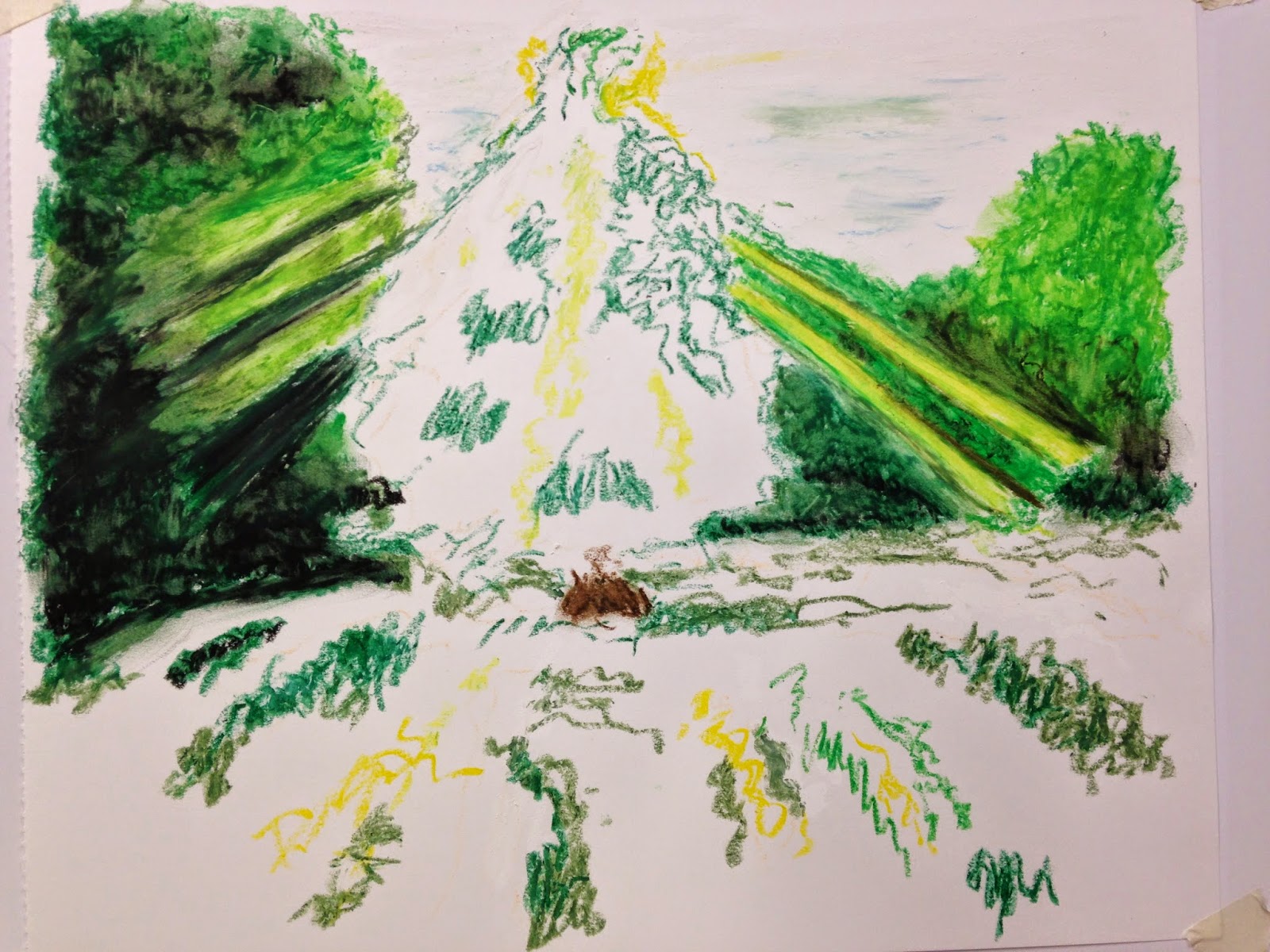
"STUMP REBORN" - PROGRESSION -- OIL PASTELS

Progression of "Stump Reborn," an oil pastel work on 11" x 14" smooth drawing paper ...

Nearly complete ...


Sensing coherence ...


Finding relationships ...


Scoping it out ...

 
(c) 2014 Wes Rehberg


MARKER SKETCH - INTERPRETING VINCENT'S VISAGE

Marker sketch -- "Interpreting Vincent's Visage" -- drawn on 5.5" x 8.5" sketch paper ...

 
(c) 2014 Wes Rehberg


Wednesday, July 02, 2014

"ELLEGUA'S EYES" -- OIL PASTEL -- 11" x 14" --

"Ellegua's Eyes" -- oil pastel 11" x 14" on smooth drawing paper -- Ellegua a Santeria figure I encountered in Cuba ...

Could be completed --

 
(c) 2014 Wes Rehberg


MARKER SKETCH - NICARAGUAN CHILDREN AT THEIR SHACK


Marker sketch – Nicaraguan children at their Managua shack, from a photo I took in 1992, drawn on 5.5” x 8.5” sketch paper …

 
(c) 2014 Wes Rehberg


Tuesday, July 01, 2014

STARTING "ELLEGUA'S EYES" -- OIL PASTEL


Starting “Ellegua’s Eyes” – oil pastel on 11” x 14” smooth drawing paper –

When I painted and drew 33+ years ago, I’d do both abstract and representational work and mix them too. Now back at it, the pattern repeats itself … I like it:


(c) 2014 Wes Rehberg


MARKER SKETCH - GALLERY, HIGH MUSEUM, ATLANTA

Quick marker sketch of a gallery in the High Art Museum in Atlanta -- from my photo on 8.5" x 5.5" sketch paper --

 
(c) 2014 Wes Rehberg


Monday, June 30, 2014

MAYAN WOMAN AND CHILD - 11" x 14" OIL PASTEL ...

Mayan Woman and Child, 11" x 14" oil pastels on smooth drawing paper -- drawn from a photo I took in Navil, Chiapas, Mexico in 1998 during a human rights effort --
Possibly completed or near it -- need to give it a rest ...

 
(c) 2014 Wes Rehberg


MARKER SKETCH - HAVANA, CUBA, STREET SCENE

Marker sketch, Havana Cuba street scene, from photo I took in 1995, drawn on 8.5" x 5.5" sketch paper ...

 
(c) 2014 Wes Rehberg
 

Sunday, June 29, 2014

MARKER SKETCH - "REFUGEES ON THE MOVE" ...

Marker sketch - "Refugees on the Move," Sunday morning drawing on 8.5" x 5.5" sketch paper -- I drew this from an internet photo (Africa, no location specified or photo credit) --

 
(c) 2014 Wes Rehberg


Saturday, June 28, 2014

MARKER SKETCH - PALESTINIAN SCHOOLCHILDREN CROSS MILITARY DEBRIS BARRIER

Quick marker sketch - Palestinian schoolchildren cross Israeli military debris barrier on way to school -- from photo I took in 2001 in Beit Ummar, the West Bank -- drawn on 8.5" x 5.5" sketch paper...
(Israeli military occupied building on left and had camo camp atop building; atop hill is an imposed large Israeli settlement - you couldn't know that from the photo either -- we stood at the barrier so the kids could pass -- UN team brought teachers to barrier so they could cross also)

 
(c) 2014 Wes Rehberg
 

Friday, June 27, 2014

PROGRESSION - DISPLACED MAYAN WOMAN AND CHILD -- OIL PASTELS

 
Progression -- Displaced Mayan Woman and Child, 11" x 14" oil pastels on smooth drawing paper -- drawn from a photo I took in Navil, Chiapas, Mexico in 1998 --

Third steps -- working on coherence ...


Second steps -- things are pretty much in place, need to work out how they relate in a coherent way and in themselves ...


Initial steps -- roughing it in, working out color, shape, style and texture --

 
(c) 2014 Wes Rehberg
 

Thursday, June 26, 2014

MARKER SKETCH - REFUGEES WALKING TOWARD TENTS

Quick sketch on 5.5" x 8.5" paper - "Refugees Walking Toward Tents"

 
(c) 2914 Wes Rehberg
 

Wednesday, June 25, 2014

COMING ALONG - "REFUGEES IN FLIGHT" - ACRYLIC PAINTING

Taking my time with "Refugees in Flight," acrylic painting on 16" x 20" canvas ... in progress.

 
(c) 2014 Wes Rehberg
 

THREE (FAUVIST) MARKER SKETCHES - 8.5"x5.5" PAPER

Messing with Fauvism, here are three marker sketches on 8.5"x5.5" sketch pad paper.


Hunter Museum of American Art, Chattanooga, Tennessee
 
(c) 2014 Wes Rehberg


Thursday, June 19, 2014

"FORCIBLY DISPLACED MAYANS" - OIL PASTEL ON CHARCOAL PAPER


Progression - "Forcibly Displaced Mayans" - oil pastel drawing on charcoal paper, 9"x10.5"
-- So be it -- finis -- (so it seems) -- but my reaction to it, starting all over again - too tentative, too careful, too controlled all at once -- mixed feeling --


Second step
Working it out little by little


First stage::
 Finding coherence with composition but the combination of oil pastels and charcoal paper isn't providing the "feel" I'm looking for. Have to find work around with this picture.


(c) 2014 Wes Rehberg

Tuesday, June 17, 2014

A THOUGHTFUL CRITIQUE FROM MY PARTNER


Eileen, my artist and artful spouse, offered a good critique of my re-emerging process with drawing and painting last night – basically, let the work talk to you, don’t force ideas on it, don’t get clever.

Same with subject, if I extend her thoughts – for example, does a work have to have a social justice theme all the time? Yet, I scan the internet for social-justice related photos and my photos and films from our human rights work for images to work from, start from anyway.

I’m drawn to the Fauvist, Social Realism and Ashcan schools in art right now but I don’t want to mimic them. Still early in this return to these art forms for me. I need to allow for discovery and spontaneous collaboration between me and the work and the subject and my capabilities and the medium, to keep in mind what Eileen said.

Thinking about my age in all this, too, 77, soon to be 78 -- so odd.

Friday, June 13, 2014

"HOMELESS" - OIL PASTEL ON CHARCOAL PAPER - PROGRESSION

"Homeless," oil pastel on 9"x12 charcoal paper -- the progression --

Maybe completed (maybe not) -- letting it be ... issues ...


Step three:
 Some more progress - slow going because of medium and paper ...


Step two:
 Some progress:


Step one:
Roughing it in ...


(c) 2014 Wes Rehberg

Wednesday, June 11, 2014

YET SEARCHING FOR STYLE ...


conjure ... conjure
Yet searching for style.
As another artist mentioned, style will find me.
But I’m cerebral too and need to conjure and analyze.
Try this, try that.
Some won’t conjure.
What hits and fits, then.

Tuesday, June 10, 2014

"NO RETURN" - 4TH IN REFUGEE SERIES..- PROGRESSIONS.

Fourth in refugee series, third drawing, "No Return," oil pastel on charcoal paper, 9"x12" - progress of drawing posted here, latest first:

Step three:
Seems completed --


Step two:
Progressing ...


Step one:
Background will be dynamic compared to stillness of elder Palestinian woman here. Feels stiff, though.


(c) 2014 Wes Rehberg


Monday, June 09, 2014

"REFUGEE WOMEN" -- OIL PASTELS ON DRAWING PAPER

Started another refugee work while painting the acrylic "Refugees in Flight" -- "Refugee Women," oil pastels on 8"x10" drawing paper ... progression posted here.

Step three:
I believe it's completed


Second step
Figuring it out:


First step:
I might go mixed media with this and use marker and pencil too:

 
(c) 2014 Wes Rehberg
 

Friday, June 06, 2014

BRIEF THOUGHTS ON ART AND DESIGN


BRIEF THOUGHTS ON ART AND DESIGN: From a time with film and photographic art, to now with work in painting and drawing again – on the edges, if there is an edge - I like to think about two things – enframing and mystery. Design itself, so long in dominance in the arts, doesn’t do it for me, in itself or for itself, no matter how wondrous the technique, unless what’s going on in a work takes me outside the frame.

DERRIDA VS GOTTLIEB: I’m drawing on Jacque Derrida’s notion of “enframing,” which in a painting is the thing within it that takes one out of the boundaries of the physical work and resets the frame (or disappears it). Mystery, an intangible, is something personal, and maybe I’ll try to explore what I mean by that sometime, but one thing I can say is that it’s part of what makes the frame disappear and brings about an internal vista.

I recall in the ‘60s looking at Adolph Gottlieb’s work at MOMA wondering when the mystery and that which would move me within the work would happen – even with perhaps understanding the notion of the alchemist in his work – Barnett Newman too. The lot of them: Rothko, Motherwell, Kline but not Diebenkorn and his versatility of approaches to a “subject.”

THE BLAUE REITER: Just to briefly sum up what I think I’m getting at, I think Kandinsky, Marc and others from this movement have a closer affinity to capturing the re-enframing and mystery I feel I want to see in a work that uses design as a key element and focus.

This is only sketchily developed, obviously ...


I’m not thinking about some of the extremes Francisco Goya went to in his paintings, but I think the so-called fine art of painting and drawing needs to open more spaces to address the impact of social and human rights issues ... I feel so passionate about this. I don’t know where that passion is coming from but it doesn’t matter; what matters is that it be expressed.
 
As a footnote – my youngest daughter is an extremely knowledgeable published art historian Ph.D. who also runs an MFA program in The Netherlands and so I write this understanding that that intelligence might descend on this and have a response that would open my eyes wider. But for now, this is it.
(c) 2014 Wes Rehberg

Tuesday, June 03, 2014

EMERGING - REFUGEES AND CHILDREN IN FLIGHT - ACRYLIC

Emerging - refugees and children in flight - acrylic on canvas - 16"x20" - progressions as I paint it ... ascending to the latest ...

Yet changing


It's taking on its form and mood ...


First day ...


(c) 2014 Wes Rehberg

Sunday, June 01, 2014

REFUGEE MAN & CHILD - OIL PASTEL SKETCH ...

Refugee man and child, oil pastel sketch, 8"x10" - feeling out an acrylic painting style as well for a larger representation of refugees, maybe a series ..

 
(c) 2014 Wes Rehberg
 
Refugees have a special meaning from when my spouse and a small group I organized in the late 90s accompanied a bus full of surviving refugees of a massacre in southern Mexico back to the massacre site to commemorate their 45 lost community members, slain by paramilitaries ...

"THE EDICT" - ACRYLIC PAINTING FEELS COMPLETE

Not sure whether it's "finished" but formally "The Edict" feels complete - acrylic on canvas, 16x20 ... may touch it up later, needs to talk back to me.

 
(c)  2014 Wes Rehberg
 

Saturday, May 31, 2014

"THE EDICT" IS EVOLVING TOWARD ITS CONCLUSION

"THE EDICT" is evolving and may be nearing its conclusion; lower portion incomplete, other areas to get minor alterations -- earlier progressions of this acrylic painting in a previous post ...


(c) 2014 Wes Rehberg


Sunday, May 25, 2014

SKETCH - PHILOSOPHER - (Søren Kierkegaard) 2014

30-minute Sunday morning sketch - Philosopher - (Søren Kierkegaard)

 
Getting the feel of it ...
(c) 2014 Wes Rehberg

Saturday, May 24, 2014

PROGRESSIONS FOR ACRYLIC PAINTING "EDICT"

Progressions from rough sketch to first acrylic painting in 33 years - "Edict" ...


Working my way back into it ... the acrylic will be different from the rough sketch and different from what appears here now.

(c) Wes Rehberg


Thursday, May 22, 2014

REUNITING WITH A PAST; PAINTING AND DRAWING ..

THIRTY THREE YEARS AGO I stopped painting and drawing after about a four year effort that included studies for a short time in Pratt Institute's master of fine arts program. Stopped cold. I'm not sure why.
But watching my artist wife at work lately, her visual arts skill, rekindled the urge to return to the mediums of the past: pencil, chalk, oil pastels, acrylic painting.
Some of these works survived the years so I've posted a few in Pinterest and also include four here. The Pinterest link is www.pinterest.com/wildclearing should you like to visit.
I'll occasionally post here some examples of how I'm doing this way, too. Here are four works from then:


(c) Wes Rehberg

Saturday, May 10, 2014

"RUST COLORED HAIR" -- UPDATED SEGMENT, NONFICTION STORY, CUBA JOURNEYS


"Rust Colored Hair" -- updated segment, nonfiction story draft, Cuba journeys --


        Aboard the chartered plane from Cancun, Mexico, the small Cuban band rocked the cabin, playing for we, the illegals, the ones who dared to defy the United States government’s prohibition against traveling to the shunned island 90 miles off the coast of Florida. A few dozen of us. Gathered by Global Exchange to violate and repudiate the U.S. blockade and its sanctions. And for me, the refusal to allow a government to prevent me from visiting with people from another land.

        This was the first of two journeys for me to Cuba during the mid-1990s. Our defiance on this trip had a penalty, the threat of 10 years in prison and a $200,000 fine. We were felonious. Troublemakers. And many of us broadcast our intentions beforehand, including me, with a local television news report and write-ups in regional newspapers. The closing shot of my TV interview showed me walking away from the camera, along a Binghamton University path in upstate New York where I was working toward a Ph.D., conveying something dramatic, maybe even exotic. Strange, I thought. The question raised in the report: “Will he get there?”

        The plane landed and we debarked, many mesmerized. Immigration did not stamp our passports when we passed through customs to hide evidence of our arrival. We boarded buses, were given flowers of welcome, and rode through Havana, stopping once for deliberation between the delegation leaders, including Medea Benjamin, now of Code Pink, and our hosts. When the bus door opened, I stepped out, alone, with my flowers, crossed the road, and gave them to an older woman among the onlookers. Spontaneous. Probably a transgression of some kind. I wasn’t showboating. I had a gift to pass along. Contact. Why I came.

        The trip became a gift, too. I wasn’t unfamiliar with so-called Third World circumstances, having traveled to Nicaragua twice, including to the northwest region along the Honduras border where the U.S.-backed contra forces marauded and murdered displaced Nicaraguans in the parched area, who chose to live in cooperatives, many of these radical Christian-based comunidades de base ecclesiales, thrown off their former properties by cotton and sugar plantation land thieves before the socialist Sandanista government revolutionaries came into power. That was history then, though. The Contra attacks were no longer necessary. The U.S. won. The Sandanistas were out of power. The base communities considered an aberration, condemned by the conservative Nicaragua Roman Catholic cardinal, the church. But a popular movement persisted despite that in Nicaragua. It wasn’t “communist” like the Cuban island. It was a means of survival, cooperative, collaborative in the midst of scarce resources, of a people who had known the feudal oppression of a dictatorship, the U.S. backed Somoza government.

Just a minute, though. A question. Wasn’t it the dictatorial Batista government that Fidel Castro and his band of insurgents overthrew? And didn’t these usurpers seek assistance from the Eisenhower administration before turning ultimately to Russia? A Cuba now entering its “Special Period” of increased impoverishment with the breakup of the Soviet Union at the time of our journey to Cuba?

A few features of the “Special Period” clearly stood out:

One, the second language taught in schools switched from Russian to English, including the courses of study open to teachers at the University of Havana. Walking alone away from our group through Havana streets, a small group of children followed me asking if I was a Russian. I said, no, I’m from the USA, which brought exclamations of surprise and greetings in English. One man walked alongside me, one of the new English teachers, trying out his own expertise in the language. He invited me to his daughter’s birthday party (a ruse for me to bring a gift, likely U.S. dollars). I smiled and declined. Still, we chatted.

Another feature, despite the proclamations of an egalitarian society, Cuba had two separate economies, the peso and the dollar, and the twain wasn’t supposed to meet, though it did via the underground market. Those who worked in the dollar economy – tourism and international commercial efforts – lived better off than those in the peso world, an elite of sorts. On both of my visits, my dollar lured prostitutes, vendors, restaurants, hotels and other amenities available to international visitors.

A third, though openly interracial – with Afro-Cubans making up about 65 percent of the population – one social policy analyst noted in her study indications of racism at the micro-levels of the distribution of goods and services, a distribution that at that level favored the more European looking Cubans. She did not hesitate to expound on her findings during an inter-American conference that I took part in at the University of Havana in 1995.

A fourth feature showed up as a plus, the availability of sophisticated medical care and the continued effort by the Cuban government to send teams of medical caregivers to other countries and to offer this care to victims of the massive Chernobyl nuclear plant meltdown in Ukraine. ...
 
 
(c) 2014 Wes Rehberg


Tuesday, April 15, 2014

RUST COLORED HAIR - SEGMENT FROM AN ESSAY IN PROGRESS


Rust Colored Hair -- segment from an essay draft, in-progress


        Aboard the chartered plane from Cancun, Mexico, the Cuban band rocked the cabin, playing for we, the illegals, the ones who dared to defy the United States government’s prohibition against traveling to the shunned island 90 miles off the coast of Florida. A few dozen of us, gathered by Global Exchange to violate and repudiate the U.S. blockade. The sanctions. And for me, the refusal to allow a government to prevent me from visiting with people from another land.

        This was the first of two journeys for me to Cuba during the mid-1990s. Our defiance on this one had a penalty, the threat of 10 years in prison and a $200,000 fine. We were felonious. Troublemakers. And many of us broadcast our intentions beforehand, including me, with a local television news report and write-ups in regional newspapers. The closing shot of the TV interview showed me walking away from the camera, along a Binghamton University path in upstate New York where I was working toward a Ph.D., conveying something dramatic, my guess. A troublemaker.

        The plane landed and we debarked, many amazed. No stamps on our passports when we passed through customs. We boarded buses, were given flowers of welcome, and rode through Havana, stopping once for some deliberation between the delegation leaders, including Media Benjamin, now of Code Pink, and our hosts. When the bus door opened, I stepped out, alone, with my flowers, crossed the road, and gave them to an older woman among the onlookers. Spontaneous. Probably a transgression of some kind. I wasn’t showboating. I had a gift to pass along. Contact.

        The trip became a gift, too. I wasn’t unfamiliar with so-called Third World circumstances, having traveled to Nicaragua twice, including to the northwest region along the Honduras border where the U.S.-backed contra forces marauded and murdered displaced Nicaraguans in the parched region, who chose to live in cooperatives, many of them radical Christian-based comunidades de base ecclesiales, thrown off their former properties by cotton and sugar plantation land thieves before the socialist Sandanista government revolutionaries came into power. That was history then, though. The Contra attacks were no longer necessary. The U.S. won. The Sandanistas were out of power. The base communities considered an aberration, condemned by the conservative Nicaragua Roman Catholic cardinal, the church. But a popular movement persisted despite that in Nicaragua. It wasn’t “communist” like the Cuban island. It was a means of survival, cooperative, collaborative in the midst of scarce resources, of a people who had known the feudal oppression of a dictatorship, the Somoza government.

Just a minute, though. Wasn’t it the dictatorial Batista government that Fidel Castro and his band of insurgents overthrew? And didn’t these usurpers seek assistance from the Eisenhower government before turning ultimately to Russia? By the time of our journey to Cuba, now entering its “Special Period” of increased impoverishment with the breakup of the Soviet Union? ...
 
(c) 2014 Wes Rehberg


Monday, April 07, 2014

EXPLORING RUSSIAN RELATED AND PROBLEMATIC THEMES


I'm researching several Russia-related and problematic themes at the moment.
Why? I'm trying to figure this out. A solid explicit reason has yet to emerge. 
The themes include:
-Russian history,
-Putin,
-Yeltsin,
-the Ukraine conflict and illicit and warlike opportunism on all sides,
-the Chechnya conflict and others,
-the polonium poisoning of former Russian spy Alexander Litvinenko,
-the assassination and work of Russian journalist Anna Politkovskaya,
-Russian organized crime,
-the Gulag,
-imprisoned then freed Russian oligarch Mikhail Khodorkovski,
-the wealth and holdings ex-Ukraine president Yevtushenko gained,
-Russian literature,
-and others, some yet to be discovered.
 I'm studying the language as well (not easy at my advanced age).
With this, I expect to post summaries of some of that research.
Why again? A solid explicit reason has yet to emerge. Maybe it's the spirit of inquiry with integrity ...

Честность - honesty, integrity


Friday, March 28, 2014

ILLUSIONS FROM "WHEN" -- STORY IN PROGRESS ...


ILLUSIONS FROM "WHEN" - in progress

Agent One started the conversation above ground.:
"Of course this between us is only a matter of convenience."
Agent Two: "For now."
"And you have the state's resources."
"A mere suspicion. We're both elusive. And your resources? An enemy, maybe?"
"The state always speaks in terms of an enemy."
"The law, then ..."
"The state has control of judges, lawmakers, hired guns, lobbyists, influence peddlers, utilization of the underworld, you know that."
"We have secrets then to share?"
"That's what makes this alliance intriguing."
"So where did those two go?"
"We are not aligned. I don't know."
"But you're familiar with them."
"Only insofar as a brief historical encounter."
"The collapsed boardwalk then?"
"A mere demonstration, I suppose. There may have been another motive."
"We both have familiarities, then. To me it was a hallucination, an illusion. Nothing in the newspapers."
"Depends on the frame of reference, doesn't it?"
The two stopped walking, realizing they lost their bearings and an actual physical connection with each other, rapt in conversation. Both Agents ran their maps through their minds, pinpointing icons showing their locations, now several blocks apart, but converging.
Agent Two: "Our physical destination must be the convergence point."
Agent One: "I'll meet you there."
At that moment, police and fire engine sirens shot cascading shrill echoes through nearby skyscrapers. Both Agents received enforcement alerts: "The Museum of Culture!" They arrived within seconds, showed respective security badges, passed through quickly set up barricades, and stepped inside. The floors and walls looked empty. The intrusion alerts quieted and a guard pointed upward. All the works of that gallery appeared to have been spread across the ceiling, undamaged, but inaccessible beyond neon-colored wires.
"They're attached, perhaps they can't be removed, even if we get through the wires," a museum official announced. "Just this gallery."
"Those two," Agent Two assumed. Agent One agreed.
Agent Two: "Oh, it's a pun."
Agent One: "Amused?"
"I shouldn't be. They're commercially sacred artifacts."
 ...
She smiled as they sat on a park bench and watched the chaos.
“Watch, this,” She said. She nodded her head.
“I don’t believe this!” an arriving fire official shouted. “The whole thing’s a hoax!”
“No, no!” a police official said. “The stuff was on the ceiling. Ask anyone inside?”
Arguments grew louder as those who witnessed the illusion claimed what they saw was real while latecomers questioned or derided them.
“How on earth could all those artifacts be hanging from the damn ceiling one minute, then be back in place the next?” one official asked. "It is physically impossible. Come on, you can't be serious."
Afterward, the city formed a commission to investigate the occurrence. They would hire physicists to help them.
Both Agents smiled.
Agent One: “Typical of your people.”
Agent Two: “And not of yours? Are you sure yours are not there, too?”

© Wes Rehberg 2014


Tuesday, March 18, 2014

THESE ARE DRAFT VERSIONS ....

I probably don't need to say this -- it helps me that the clarification is specified though.
Some texts in posts have since been altered, even radically, as I weave things in a story.
Drafts, then, is what's in this blog.
Posted with trepidation.

Tuesday, March 11, 2014

ANOTHER EXCERPT FROM "WHEN" -- STORY IN PROGRESS

Another excerpt from "When" ...
------------------------------------
Speaker One and Speaker Two sat at a little round cafe table in the middle of a noisy chain restaurant and bar. The waitress came.
Speaker One: The special.
Speaker Two: The same.
She: Will it be the same then?
Both speakers: Of course, what else?
When She returned, She brought blackened catfish, baked potato and mixed vegetables for Speaker One and placed it on the table. In front of Speaker Two, She placed barbecued chicken wings, celery and sauce, and french fries.  Voilá, She said.
Both speakers: See? The special. The same.
The bartender, He, shouted to the other patrons to rise, circle their table, and applaud.
Speaker Two: No illusions here.
Speaker One: Thank you, all. Thank you. Enjoy our meal.
Both got up from the table and exited the restaurant.
Images of them eating remained.

What else now? He asked.
The museum, She said.
They rode the subway.
In their car, Speaker One sat at one end, Speaker Two at the other. They texted each other, oblivious to others aboard..
She intercepted the messages and displayed them on the train's windows, invisible to the two. Occasional lights in the dark subway tunnel flickered behind.
Speaker One's message: "They're on board with us."
Speaker Two's message: "How can you tell?"
Speaker One's message: "Our car is decoupled, we're coasting."
Speaker Two's message: "Wait ... we're pulling into the station."
Speaker One's message: "That means when the train pulls out, we'll be left behind."
Speaker Two's message: "No problem, this is our stop. "
Others on the car observed the interplay of messages, looked at who might be transmitting them, and headed for the doors. The doors opened. They all exited and turned to look at the car. The doors closed. The car left the station with the rest of the train.
"What the hell was that?" a subway patron asked, angered. "I got off, but this ain't my friggin' stop!"
Others turned looking for someone to blame. Speaker One and Two stepped on the escalator. Halfway up, it stopped.
Speaker One: "We'll have to walk the rest of the way."
The escalator started again.
Speaker Two: "No we won't"
The angry man shouted. "It was those two!" Others turned to look. Just then another train pulled into the station. "Forget it," one of the others said. "Here's another ride. There's always another one."


 © 2014 Wes Rehberg

Sunday, March 09, 2014

SHORT EXCERPT FROM "WHEN," STORY IN PROGRESS ...

Short excerpt from "When" ... 
------------------------------
Look behind the illusion, like journalists are supposed to. These two are a layer beneath, under the myth that is perpetuated on the superficial membrane that most take for reality, the game of the frame, said the one speaker
Oh, such cynicism, said the other.
That's it. Swallow it whole. Did not the boardwalk collapse? The journalists will be told how it happened, will read the documents given to them in conspiratorial tones like precious manna that's really manure. Even though one of them may have witnessed what we had.
Oh, it was a hallucination.
How can you depart from your senses like that, said the one speaker.

She leaves the frame of the two speakers' reference and slips between them, ephemeral. He, a wisp, with her, coils a filament around their left ankles. She and he merge and sing in one voice. The sound brightens the filaments and sends a message along the outermost layer of the two speakers' skin so that it appears to be both sound in their ears and printed words to their optic nerves.
See, said the one speaker. Is that a hallucination?
I am still suspicious. Are we getting the same message? said the other.

---------------
© 2014 Wes Rehberg

Saturday, March 08, 2014

FROM "WHEN," A WRITING IN PROGRESS

FROM "WHEN," IN PROGRESS ...

I could waste our time and talk about the inner sense of torque she used to remove the carriage bolts without a tool in her hand.
It was evanescent.
That is such a trite word. The whole thing collapsed.
Boardwalk and all.
It was the argument on the boardwalk along the beach.. A question of scale.
When?
When they were talking about scale.
What they expect? Of course they would have to shrink.
But then the estimate could be wrong. Too small. Too large. They're too random, careless.
They use a frame of reference.
Oh sure, them. Disrupting. Decoupling. Oblongs into wisps of steam and she shouting "integrity."
When?
At the estimated appropriateness. She never misses.
He's the randomizer though. Clever. Subtle, like an atmosphere of illicit behavior.
All of it.
---------------
© 2014 Wes Rehberg